You must understand the market so that you can offer what the client asks for and needs.
An increasing number of companies are choosing to move part or all of their infrastructure to the cloud.
This is no longer just a technological trend; it is an operational model that provides flexibility, reduces reliance on physical hardware, and offers access to resources that scale in tandem with the business.
However, cloud services for businesses go far beyond simply setting up a server on the Internet. The cloud encompasses a broad range of solutions, from application hosting and server virtualization to data backups and the migration of entire infrastructures.
In this article, we review the primary cloud services for businesses and the key factors they should consider before choosing us as their provider.
What are cloud services for businesses?
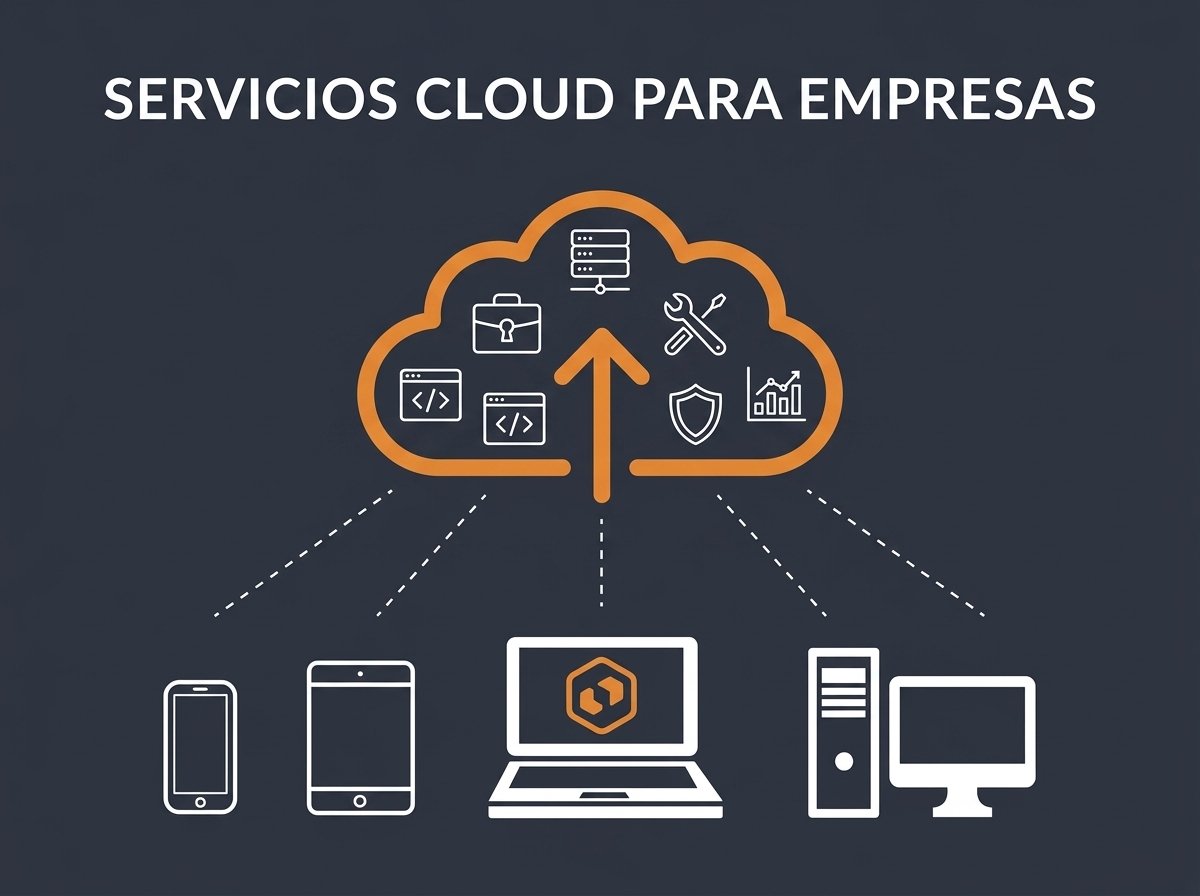
Cloud services allow companies to utilize computing resources hosted in specialized data centers, eliminating the need to maintain all infrastructure on-site. These resources include:
- Virtual Private Servers (VPS)
- Data storage
- Virtual networks
- Backups
- Disaster recovery systems
- Virtualized infrastructures
- Platforms for hosting business applications
Instead of purchasing and replacing physical servers every few years, a company can procure these resources from you on an as-needed basis, tailored to their specific requirements.
Key advantages of the cloud
Adopting the cloud offers benefits that extend well beyond hardware cost savings.
- Scalability. One of the most compelling aspects of the cloud is the ability to scale resources whenever the business requires it. If an application needs more memory, processing power, or storage, you can adjust the infrastructure without having to replace physical hardware.
- Higher availability. Cloud services run on infrastructure designed for high availability, which helps minimize downtime and ensures business continuity, even in the event of hardware issues.
- Reduced maintenance. By eliminating a large portion of your physical infrastructure, you spend less time on maintenance tasks and more on strategic projects for the company.
- Flexibility. The cloud facilitates access to systems from various locations and allows your infrastructure to evolve in step with the organization's needs.
What cloud services do companies need?
Not all companies have the same requirements. Some may only need to host an application server, while others require a complete infrastructure with multiple servers, shared storage, backups, and network services.
These are the most common solutions:
- Virtual Private Servers (VPS). These provide you with virtualized machines. They are a widely used option for hosting business applications, websites, databases, or internal services.
- Cloud infrastructure. When a company requires multiple interconnected servers, private networks, shared storage, and greater growth potential, a cloud infrastructure offers significantly more flexibility than a single server.
- Backups. Having a backup strategy is essential to protect data against human error, technical failures, or ransomware attacks. Ensure that backups are integrated into any cloud infrastructure, regardless of its size.
- Cloud migration. Many companies still rely on physical servers or on-premises infrastructure. Migrating to the cloud allows you to modernize these environments without needing to replace the entire infrastructure at once—provided the process
is properly planned.
How to choose a cloud provider
Choosing a provider based solely on price can prove costly in the long run. Before making a decision, it is advisable to evaluate factors such as:
- Infrastructure quality
- Service availability
- Technical support
- Scalability
- Security options
- Backup capabilities
- Ability to customize the infrastructure
- Experience with migration projects
Every company has unique needs, and as a provider, you must be able to offer the right solution.
When is it worth migrating to the cloud?
There is no single moment that applies to every company, but there are several scenarios that often indicate it is time to propose a change:
- Current servers are reaching the end of their useful life.
- There is a frequent need to scale up resources.
- Hardware maintenance entails high costs.
- The goal is to improve service availability.
- The company needs to facilitate remote access to its applications.
- They want to reduce reliance on physical infrastructure.
In such cases, a well-planned migration can simplify system management and prepare the infrastructure for future growth.
A cloud infrastructure tailored to each company
As you well know, not every organization requires the same solution.
Some may need only a single virtual server, while others require a complete infrastructure capable of supporting mission-critical applications, multiple users, and large volumes of data.
Begin the project with a detailed analysis of the existing infrastructure, with the goal of designing a solution tailored to the company’s actual needs.
This phase alone is worth its weight in gold—often, clients don’t even know what they currently have.
So, charge accordingly—ideally, upfront.
When the migration demands it, plan the process to minimize downtime. If necessary, keep certain services on-premises using an Edge Compute Server, thereby facilitating a gradual and controlled transition to the cloud.
Adopting cloud services is about more than just changing where servers are hosted. It is about building an infrastructure designed to grow, adapt to the business, and provide the stability your client needs—both today and in the future.